Bedroom Blueprints to Billion-Dollar Shelves: How Open-Source Fabrication Is Rewriting the Hardware Playbook
There's a running joke in maker circles that the most dangerous phrase in the English language is "I could probably just build that." It starts innocently — a weekend project, a borrowed drill press, a spool of PLA filament — and before long you're shipping orders out of your dining room at midnight, wondering how it all happened.
That journey, from a half-baked idea to an actual product on actual shelves, used to require serious capital, industry connections, and a manufacturing partner willing to take a chance on an unknown. Not anymore. The rise of affordable, open-source digital fabrication tools has quietly flattened a playing field that was once brutally tilted toward incumbents. And the makers taking advantage of it are doing things that would have seemed genuinely impossible a decade ago.
We talked to four of them.
From Dorm Room to Farmers Market: Jess and the Laser-Cut Jewelry Empire
Jess Tran started cutting acrylic earrings in her college apartment in Austin, Texas, using a secondhand K40 laser cutter she picked up for $400 on Craigslist. She'd been selling hand-painted pieces at local markets for two years, but the per-unit time cost was killing her margins.
"I found Inkscape tutorials online, then stumbled onto community forums where people were sharing cut files for free," she says. "I realized I could prototype a new design in an afternoon instead of a week."
The open-source software stack — Inkscape for design, LaserWeb for machine control — meant Jess didn't spend a cent on proprietary CAD tools. She iterated fast, crowdsourced feedback at weekend markets, and refined her designs based on what actually sold. Within eighteen months, she'd moved from farmers markets to a regional boutique chain, and her Etsy shop now does consistent five-figure monthly revenue.
The barrier she talks about most wasn't technical. It was psychological. "I kept waiting for permission to call myself a manufacturer," she laughs. "At some point I just decided I already was one."
The Wheelchair Accessory Nobody Was Building
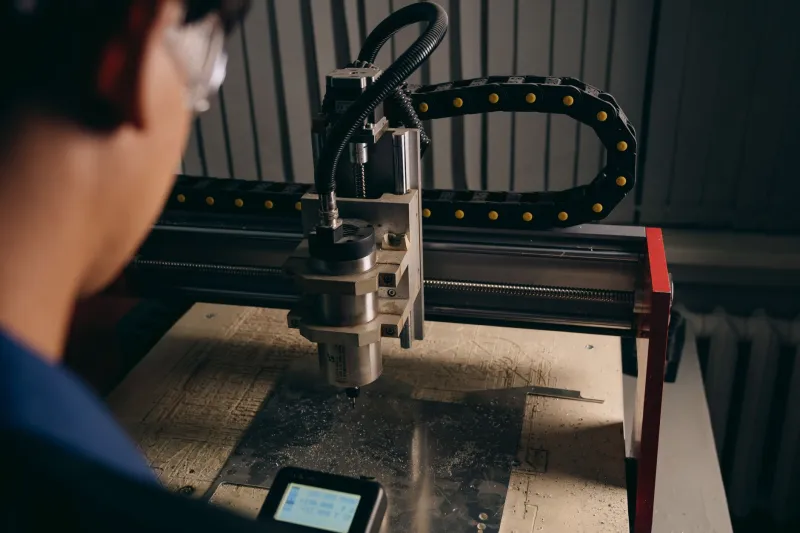
Marcus Webb spent years frustrated by the lack of affordable, customizable accessories for manual wheelchairs. Commercial options were expensive, ugly, and rarely designed with actual users in mind. So he built his own — a modular side-bag mounting system machined from aluminum on a hobbyist CNC router.
Marcus is based in Detroit and works out of a shared makerspace that charges $150 a month for full shop access. His design files live on GitHub under a Creative Commons license. Anyone can download them, modify them, and cut their own version. He also sells finished units through a small Shopify store for people who don't have shop access.
"Open-sourcing the design was a business decision as much as an ethical one," he explains. "It built a community of users who gave me feedback I never would have gotten otherwise. People modified the design for their specific chairs and sent me the files. My v3 is basically a collaboration between me and forty strangers on the internet."
Marcus hasn't quit his day job yet — he's transparent about that — but the product line now covers his makerspace membership, material costs, and then some. More importantly, it exists. Before him, it didn't.
Scaling Without a Factory: The 3D-Printed Hydroponics Hardware Story
When Priya Nair and her partner started building a compact hydroponic grow system for apartment dwellers, they assumed they'd eventually need an injection mold and a contract manufacturer. That assumption cost them six months of paralysis.
"We kept thinking we had to wait until the design was perfect before we could manufacture anything," Priya says. "Then we just started printing parts on our Bambu Lab printer and selling them. People loved the imperfect version."
Their system — a wall-mounted, modular growing unit designed in FreeCAD and printed in food-safe PETG — has gone through eleven major design revisions since its first sale. Each revision was informed by customer feedback. Each updated file got pushed to their public repository. A small but loyal community of users now contributes remix designs and troubleshooting guides.
Priya's company, based in Portland, Oregon, now sells both complete printed kits and raw design files for makers who want to print their own. The dual-track model — product and open design — has become a real competitive advantage. "We're not scared of people printing our stuff themselves," she says. "Those people become our loudest advocates."
CNC Furniture and the Myth of the Minimum Viable Factory
Derek Osei builds furniture in a two-car garage in Columbus, Ohio. His pieces — clean-lined, flat-pack shelving and tables designed for urban apartments — are cut on a Shapeoko CNC router and finished by hand. He sells them directly through Instagram and a simple website.
Derek's background is in graphic design, not woodworking or engineering. He taught himself CAD using free YouTube tutorials and the documentation maintained by open-source communities around tools like Carbide Create and Kiri:Moto. "I had zero manufacturing experience," he says. "I just had a lot of time during the pandemic and a router I bought on installment."
What he's figured out is that the open-source fabrication ecosystem doesn't just lower the cost of tools — it lowers the cost of learning. Forums, shared files, community Discord servers, and freely available documentation have compressed what used to be years of trade apprenticeship into months of focused self-teaching.
His furniture isn't trying to compete with IKEA on volume. It competes on story, craft, and the specific appeal of buying something made by a real person in a real garage. That positioning only works because his overhead is low enough to make the economics viable — and his overhead is low because of the tools he uses.
What These Stories Actually Have in Common
Look past the specific products and you'll see a consistent pattern. None of these makers started with significant capital. None of them had manufacturing industry connections. All of them relied heavily on open-source software, community knowledge, and the kind of iterative, low-stakes prototyping that accessible fabrication hardware makes possible.
They also all talk about community as infrastructure. The forums, the shared files, the Discord servers — these aren't just nice extras. They're load-bearing. When Marcus's CNC router started producing weird chatter marks, he posted a video in a community forum and had a diagnosis within two hours. That kind of distributed expertise is genuinely new, and it's genuinely powerful.
The barriers that remain are real: access to physical shop space, the time to learn new tools, the emotional labor of putting something you made into the world and waiting to see if anyone cares. Open-source tooling doesn't dissolve those challenges. But it removes enough of the financial and technical friction that the remaining obstacles start to feel surmountable.
The Bigger Picture
Hardware has always been harder than software. Physical things break, ship late, and cost money to store. The conventional wisdom was that you needed serious funding before you could take hardware seriously.
That wisdom is getting outdated fast. The combination of open-source fabrication tools, shared manufacturing knowledge, and direct-to-customer sales channels has created something genuinely new: a viable path from garage project to real business that doesn't require a venture capitalist's blessing.
Jess, Marcus, Priya, and Derek aren't outliers. They're early signals. The tools keep getting better, the communities keep growing, and the barrier between "I could probably just build that" and actually building it keeps shrinking.
The garage is back. And this time, it scales.