Snapping Together Shouldn't Be This Hard: The Broken Promise of Modular Fab Tools
Pick up almost any catalog from a digital fabrication hardware company and you'll find the same language: seamless integration, plug-and-play, modular by design. It sounds like a maker's dream — a workshop ecosystem where your laser head swaps onto your CNC gantry, your control board talks to every spindle you own, and upgrading one piece doesn't require rebuilding everything around it.
Except it rarely works that way.
Talk to makers who've actually tried to build modular workflows and a different story emerges — one full of incompatible connectors, firmware conflicts, and the quiet grief of realizing that "compatible with most systems" means compatible with almost none of yours.
What 'Modular' Actually Means (Depending on Who You Ask)
Here's the problem nobody puts in the spec sheet: "modular" doesn't have a standard definition in the fabrication tool space. For some manufacturers, it means their own product line snaps together nicely. For others, it's a marketing term applied to anything with a detachable part. And for open-source developers, it usually means something closer to configurable with enough effort and patience.
Those are three completely different things, and conflating them is where the frustration begins.
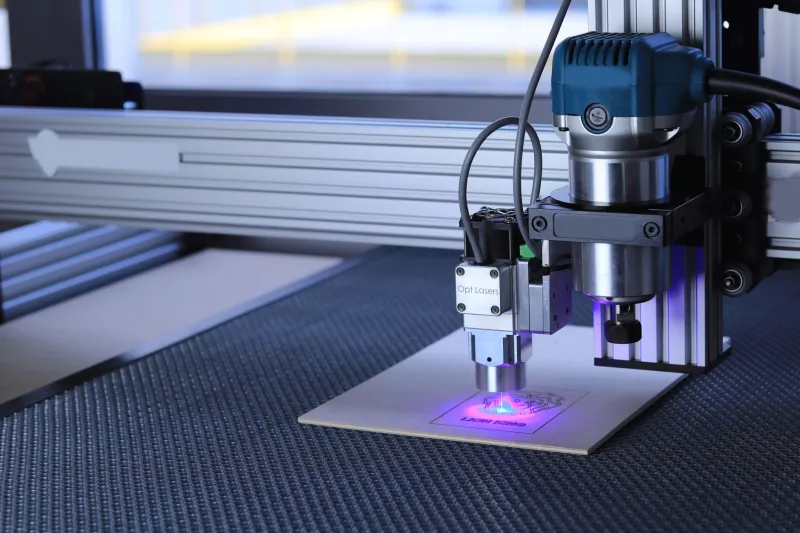
A maker in Portland spent four months trying to build a hybrid machine that combined a diode laser module with a drag-knife cutter on a shared motion platform. Both components were advertised as modular. Both had active community forums. Neither was designed with the other in mind, and the control software for each assumed it was the only tool in the chain. "I ended up writing my own middleware just to get them to share a coordinate system," she said. "At that point, I wasn't making things anymore. I was just doing IT work in my garage."
That experience is more common than the industry likes to admit.
The Hidden Complexity Nobody Advertises
True interoperability — the kind where different tools from different makers actually cooperate without heroic effort — requires agreement at multiple levels simultaneously. Physical connectors have to match. Communication protocols have to align. Software has to share assumptions about units, axes, and error handling. And firmware has to expose the right hooks for external control.
Miss any one of those layers and you don't have a modular system. You have a collection of parts that almost work together.
Developers building open-source fabrication tools are acutely aware of this. The teams behind projects in the broader fab modules ecosystem will tell you that physical compatibility is the easy part. "Getting two tools to share a physical interface takes an afternoon," one developer noted in a community thread last year. "Getting them to agree on what 'home position' means, or how to handle an emergency stop signal from a third-party board — that's where months disappear."
The deeper issue is that genuine modularity requires upfront coordination between developers who often have no financial incentive to collaborate, and sometimes have active reasons not to. When your business model depends on selling a complete ecosystem, making it easy to swap in a competitor's spindle head isn't exactly a priority.
When Standards Help (And When They Don't)
The fabrication community has tried to solve this through standards — and it's worked, partially. G-code remains the closest thing the CNC world has to a universal language, and its widespread adoption genuinely does make a lot of motion control more portable than it used to be. Likewise, standardized stepper driver pinouts and common form factors like NEMA 17 mounts have made certain physical swaps genuinely painless.
But standards have a ceiling. They tend to cover the basics well and fall apart at the edges — exactly where modular ambitions live. The moment you want to do something slightly unusual, like synchronizing a rotary axis with a laser pulse timing signal, you're back to custom solutions and community forums at midnight.
And even when standards exist, adoption is inconsistent. A maker in Austin trying to build a pick-and-place attachment for his router discovered that two boards both claiming "GRBL compatibility" handled soft limits in completely different ways. Both were technically correct. Neither worked together without manual configuration that took him two weekends to figure out.
The Maker Tax Nobody Talks About
There's an informal cost that modular-tool buyers rarely anticipate: the time and expertise required to make the promise real. Call it the maker tax. It shows up as debugging sessions, community forum searches, firmware rewrites, and the occasional rage-quit that costs you a weekend.
For experienced makers with strong software skills, this tax is annoying but manageable. For newer makers — especially those drawn to modular tools precisely because they seem approachable — it can be genuinely discouraging. The gap between "I bought the modular kit" and "I have a working modular system" can be measured in weeks, not hours.
This matters because it shapes who ends up succeeding with these tools. The makers who push through aren't always the ones with the most creative ideas. Sometimes they're just the ones with the most time and the highest tolerance for frustration.
What Would Actually Fix This
The makers and developers who've thought hardest about this problem tend to land in similar places. First, honest marketing: stop calling something modular if what you mean is upgradeable within our product line. Second, open protocols: the more fabrication tool communication happens over documented, community-maintained interfaces, the better the interoperability odds get. Third, reference implementations: working examples of cross-vendor tool combinations, maintained by the community and tested against real hardware, would save thousands of hours of duplicated debugging.
Some of this is already happening. Communities around open-source motion control projects have started maintaining compatibility matrices — essentially crowd-sourced documentation of what works with what. It's not glamorous, but it's genuinely useful.
The harder shift is cultural. Modularity as a real engineering value, rather than a marketing claim, requires developers to prioritize interoperability even when it's inconvenient. That means publishing full interface specs, engaging with the broader community during design, and being honest about what a tool's modular claims actually cover.
The Promise Is Still Worth Chasing
None of this means modular fabrication is a dead end. The underlying idea — that makers should be able to compose their own workflows from best-in-class components, rather than being locked into any single vendor's vision — is genuinely compelling and worth pursuing.
But the gap between the promise and the reality is real, and it's costing makers time, money, and enthusiasm. The first step toward closing that gap is naming it clearly: modular fabrication tools, as currently sold, often aren't. Building ones that actually are will take more coordination, more honesty, and more community investment than the industry has offered so far.
Makers deserve better than a label. They deserve tools that actually snap together.