Your Next Design Assistant Doesn't Sleep: AI Finds Its Way Into the Fab Workflow

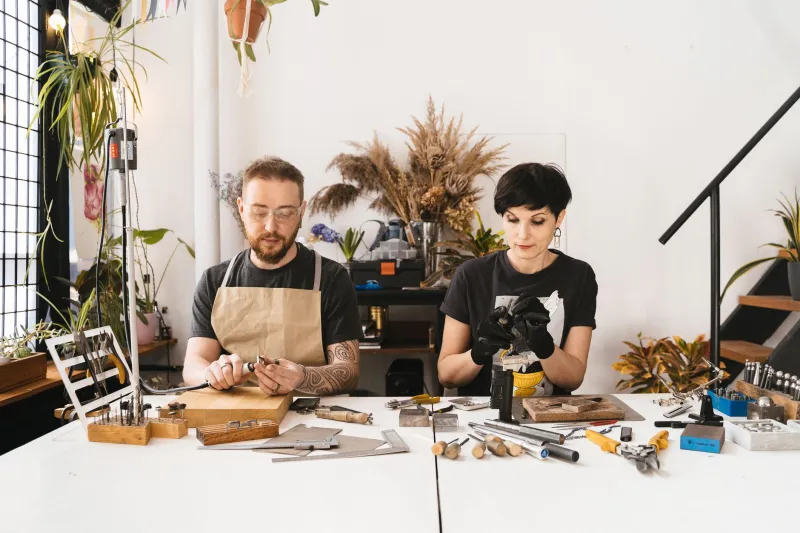
Photo: AI generative design CAD software glowing screen workshop maker, via www.owlgen.org
Somewhere in a makerspace in Columbus, Ohio, a woodworker is using a generative AI tool to optimize the nesting layout of her CNC router cuts. The software analyzes her design files, predicts material grain direction, and rearranges the cut order to reduce waste by about 18 percent. She didn't ask it to do most of that. It just did.
That's the thing about AI entering the fabrication workflow: it rarely announces itself with fanfare. It shows up quietly, as a smarter autocomplete in your CAD tool, a material cost estimator that actually learns from your past projects, or a slicer that adjusts infill density based on stress modeling you never ran yourself. And then one day you look up and realize the machine is making more decisions than you thought.
The Productivity Case Is Hard to Argue With
Let's be honest about the upside first, because it's real and it's significant. For makers working on tight timelines or with limited material budgets, AI-assisted toolpath optimization and design generation aren't luxuries — they're starting to feel like competitive necessities.
The waste reduction angle alone is compelling. Material costs have climbed steadily over the past few years, and the ability to algorithmically pack more parts onto a single sheet of plywood or aluminum stock translates directly into lower project costs. Several open-source slicer and CAM tools have begun integrating basic ML-driven nesting, and early user reports suggest savings of 10 to 25 percent on material use — numbers that add up fast if you're running a small production operation.
On the design side, generative tools are getting genuinely useful for structural optimization. Feed a tool your load requirements and material constraints, and it'll propose geometries that a human designer might never have considered — organic lattice structures, variable-density infill patterns, ribbing configurations tuned to specific stress distributions. For makers building functional parts rather than decorative ones, this kind of automated structural reasoning can surface solutions that are both stronger and lighter than intuition would suggest.
Where Makers Are Pushing Back
Not everyone in the community is cheering. And the concerns aren't just reflexive technophobia — they're specific, grounded, and worth taking seriously.
The skill erosion argument is probably the most common one you'll hear in makerspace conversations. The worry is that when AI handles design optimization, toolpath sequencing, and material selection, newer makers never develop the intuition that comes from doing those things manually. You don't learn why a certain cut sequence reduces tear-out if the software just handles it for you. You don't build a feel for material behavior if an algorithm is making the material choices.
This matters because maker expertise isn't just about outputs — it's about the knowledge that accumulates through iteration, failure, and problem-solving. A community of makers who've outsourced their thinking to AI tools might produce cleaner results in the short term while quietly hollowing out the skill base that makes innovation possible in the long term.
There's also a copyright question that the fabrication community hasn't fully worked out yet. When a generative design tool produces a component geometry, who owns that design? If the model was trained on community-contributed files — as many are — do the original contributors have any stake in what gets generated? These aren't hypothetical concerns. They're live debates happening in open-source design communities right now, and the answers will shape how AI tools integrate into collaborative maker culture.
The 'Is It Still Making?' Question
Under all of this runs a more philosophical current: if an AI generates your design, optimizes your toolpaths, and predicts your material behavior, are you still the maker?
Most experienced makers land somewhere nuanced on this. The comparison to other tools comes up a lot. Nobody questions whether using a CNC router instead of a hand chisel makes your work less legitimate. Nobody says a laser cutter disqualifies you from the maker community. Tools have always extended what humans can do, and AI is arguably just another extension.
But there's a qualitative difference that's hard to dismiss entirely. A CNC router executes your decisions with precision. A generative AI makes decisions of its own — decisions that reflect training data, optimization objectives, and model architectures that you didn't choose and may not fully understand. The locus of creative agency shifts in a way that doesn't have a clean precedent in earlier tooling.
For now, most makers seem to be treating AI tools the way they'd treat any powerful but unfamiliar machine: useful when you understand its limitations, dangerous when you trust it blindly.
How Open-Source Projects Are Navigating the Shift
The open-source fabrication community is approaching AI integration with characteristic pragmatism — building tools that augment maker decision-making rather than replace it, and keeping the underlying models transparent and auditable where possible.
Several projects in the broader digital fabrication space are experimenting with ML-assisted toolpath suggestion that presents options rather than making automatic choices, letting the maker stay in the decision loop. Others are building material waste trackers that learn from individual workshop behavior over time, giving makers better data about their own patterns without automating the choices themselves.
The emphasis on transparency matters. When a black-box algorithm optimizes your design, you learn nothing. When a tool explains why it's suggesting a different cut order or a different infill density, it becomes a teaching mechanism rather than a replacement for expertise.
What Comes Next
AI in fabrication is early enough that the community still has meaningful influence over how it develops. The decisions being made right now — about how much agency to give algorithms, how to handle training data attribution, how to keep tools legible to the people using them — will shape what maker workflows look like five years from now.
The technology isn't going away. The question is whether the maker community engages with it actively, pushing for tools that enhance skill rather than substitute for it, or whether it ends up with AI-assisted fabrication that serves the needs of the platforms selling it more than the people using it.
That's a community choice. And historically, makers are pretty good at those.