One Laser, No Crew: The Hidden Cost of Making Alone

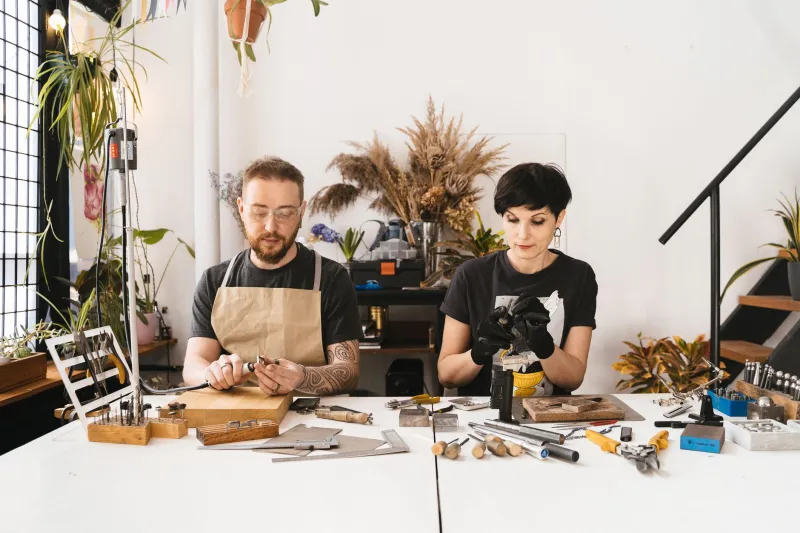
Photo: solo maker alone workshop laser cutter dim light quiet, via blogger.googleusercontent.com
There's a particular quiet that settles into a home workshop late on a Tuesday. The laser cutter hums, the ventilation fan runs, and the only voice in the room is a YouTube tutorial you've already watched twice. You're making something. You're productive. And somewhere underneath that productivity, something is missing.
It's a feeling more makers know than talk about. As digital fabrication tools have gotten cheaper, better, and more capable, the friction of making has dropped dramatically. You don't need a makerspace membership to access a laser cutter anymore. You don't need a woodworking club to get help designing a joint — there's a forum for that, a Reddit thread for that, a Discord for that. The tools and the knowledge are more accessible than they've ever been.
And yet.
The Convenience Trap
On-demand fabrication services have taken accessibility even further. Send your files to any number of online services and get back finished parts in aluminum, acrylic, or carbon fiber without ever touching a machine. For prototyping and one-off production runs, it's genuinely transformative. For learning, it's a short-circuit.
When you outsource the physical making, you also outsource the education that lives inside it. The moment a part comes back wrong and you have to figure out why — that's a lesson. The conversation with the person running the CNC about why your tolerances are off — that's a lesson too, one that doesn't happen when the failure just shows up in a shipping box and you send a support ticket.
This isn't an argument against on-demand services. They're useful, sometimes essential. But there's a version of modern making where the tools are powerful, the services are convenient, and the maker is quietly becoming less capable with every project because the hard parts — the parts where learning actually happens — keep getting handed off.
What Isolation Does to Innovation
Maker culture has always run on cross-pollination. The person who builds furniture notices something about joinery that turns out to be useful to someone building robotics enclosures. The electronics hobbyist figures out a power management trick that the e-textile maker on the other side of the room immediately adapts. These collisions don't happen in solo workshops. They don't happen in Discord servers either, not in the same way — not with the same spontaneity, the same physical proximity to the work, the same ability to point at a thing and say look at what's happening here.
Research on creative collaboration consistently finds that proximity matters. Ideas spread faster and mutate more productively when people share physical space and can observe each other's processes in real time. The maker community built its early momentum in exactly this kind of environment — shared shops, open build nights, hackathons where you could look over someone's shoulder and immediately see what they were trying to do.
Solo making, done in isolation over long stretches, tends to produce work that's technically competent but conceptually narrower. You get better at the things you already know how to do. You get less exposure to the approaches, materials, and problem-framings that might expand what you're capable of imagining.
The Mental Health Piece Nobody Posts About
There's something else that doesn't get much airtime in maker content, because maker content tends to be aspirational and optimistic: making alone, for long enough, can get lonely in ways that compound.
The workshop becomes a refuge, and refuges are good until they become the only place you feel competent or comfortable. Makers who've moved from active community participation to primarily solo work describe a gradual narrowing — fewer conversations about their projects, less external feedback, a growing sense that what they're building exists in a kind of vacuum.
This isn't unique to makers. It's a pattern that shows up anywhere people do skilled, absorbing work in isolation. But the maker community is worth paying specific attention to because so much of its self-image is tied up in independence and self-sufficiency — values that can quietly shade into isolation without anyone naming it as a problem.
The rise of social media documentation — posting your builds, getting likes, reading comments — fills some of this gap but not all of it. Asynchronous validation isn't the same as real-time collaboration. A comment thread isn't a build night.
The Ways Makers Are Finding Each Other Again
Here's the encouraging part: makers are finding creative ways to rebuild connection without giving up the autonomy that home workshops and solo practice provide.
One pattern showing up in cities across the country is the informal build club — small groups of four to eight makers who meet regularly, usually in rotating home workshops or rented studio time, specifically to work on their own projects in shared physical space. No formal curriculum, no membership dues, no institutional overhead. Just people making things in the same room and talking about what they're doing.
Another is the remote collaboration model, which is more intentional than a Discord server. Small groups of makers commit to shared project timelines, regular video check-ins where they show physical work in progress, and peer critique sessions with enough depth to actually change what someone builds. It's not the same as being in the room, but it's structured enough to create real accountability and real feedback.
Some makerspaces that lost foot traffic during the pandemic years are rebuilding by narrowing their focus — instead of trying to serve everyone, they're building tight communities around specific crafts or materials, creating environments where regulars actually know each other and institutional knowledge passes between people rather than living only in posted signs.
Making Is a Social Act, Even When It Feels Solitary
Every project a maker builds draws on knowledge that came from somewhere — a tutorial someone wrote, a technique a mentor demonstrated, a design pattern that circulated through a community over years. Making has always been social at its roots, even when the work itself happens alone.
The tools that make solo making easier are genuinely valuable. But they work best as part of a broader practice that includes other people — people who will tell you when your design is wrong, show you a technique you'd never have found on your own, or just be present while you work through a problem out loud.
The loneliness of the solo fabricator isn't inevitable. It's a choice, made gradually, that can be unmade the same way — gradually, by showing up somewhere with your work and letting other people see it.
The machine doesn't care if you're alone. The maker probably should.